
BIRD’S-FOOT TREFOIL
Lotus corniculatus
BEAN FAMILY (Fabaceae)
 Identification
- Flowering time - May, June, July, August, September, October
- Rare at FF - not yet seen at NW, but likely in disturbed areas
- Low growing, sprawling plant
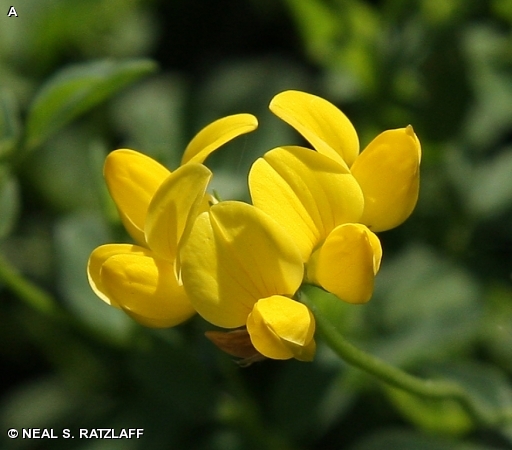
- Bright yellow pea-like flowers
- 5 leaflets - 3 clover-like plus 2 above


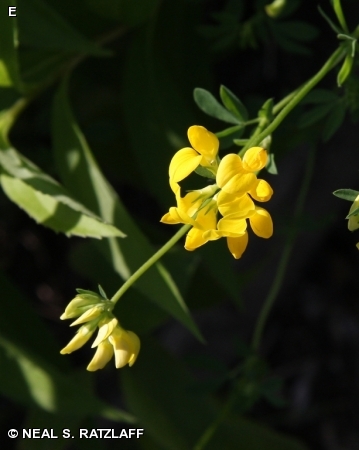
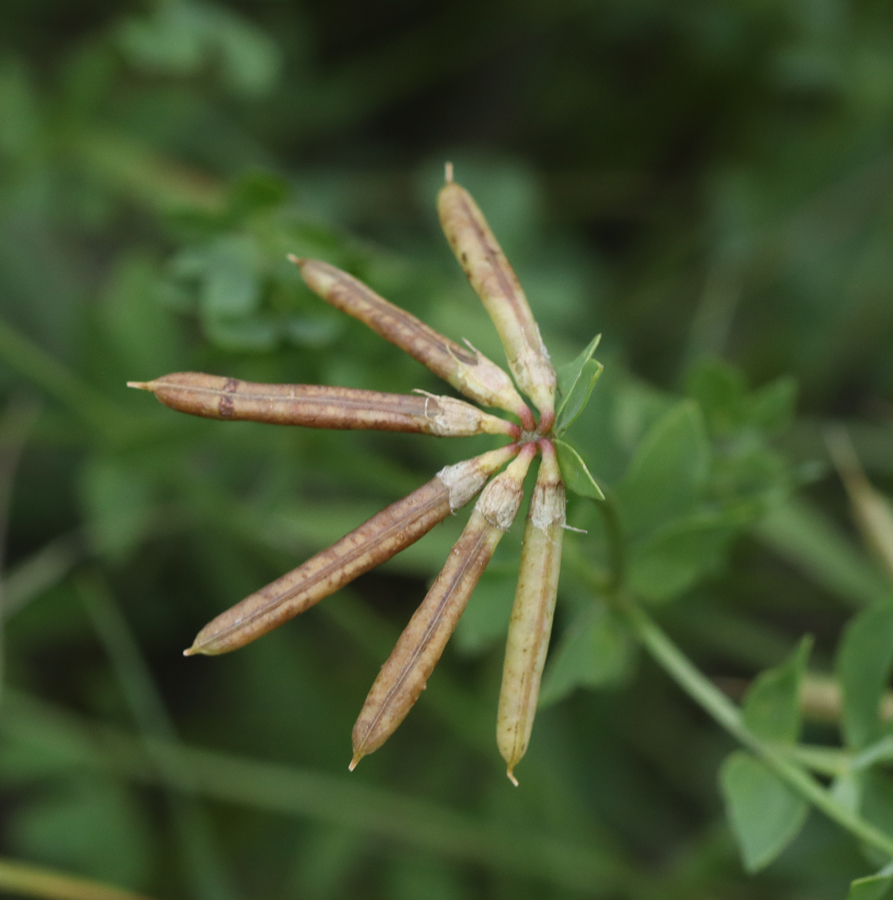
An introduction from Europe, this low-growing, sprawling perennial usually is no more than a few inches tall, but has from one to several weak, reclining stems up to 2 feet long (B,C). Leaves are compound with 3 clover-like leaflets grouped together at the tip and two more at the base of the leaf stem (D). Clusters of 2-8 sweet pea-like flowers develop at the tip of a long flower stalk (E). Flowers are bright yellow, sometimes with orange-red markings (A). The entire flower may turn orange at maturity. Clusters of cylindrical, one inch long seed pods resembling a bird’s foot contain up to 50 small light to dark brown seeds (F).
Bird’s-foot Trefoil, introduced from Europe as a forage and hay plant, has escaped into disturbed areas and roadsides. It has also been planted along roadsides for erosion control. It is rare in Fontenelle Forest where a single large clump was found in the garden planting across the road from the Gifford Road floodplain parking lot. This plant, now common most everywhere in our area, very likely will appear elsewhere at our nature centers in coming years. Flowering occurs from May to October.
The content of NatureSearch is provided by dedicated volunteer Naturalists of Fontenelle Forest who strive to provide the most accurate information available. Contributors of the images retain their copyrights. The point of contact for this page is: Neal Ratzlaff.