
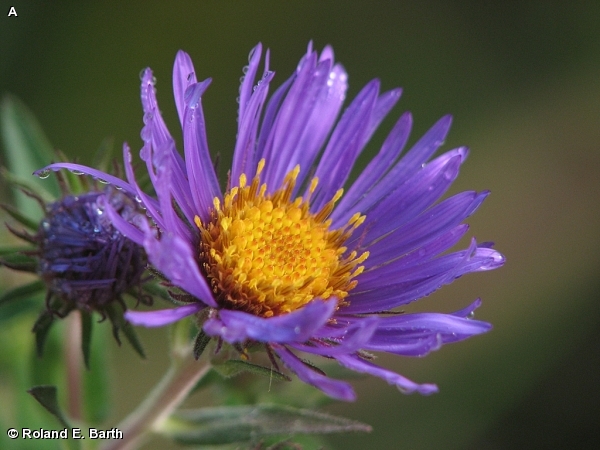
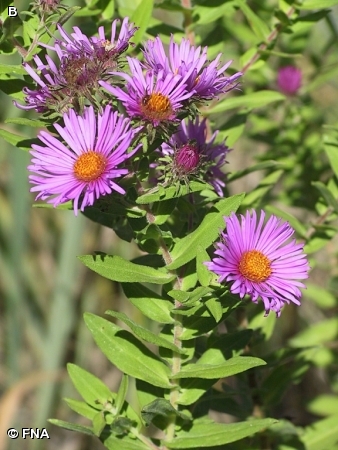
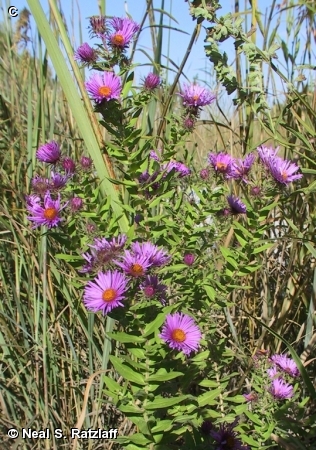
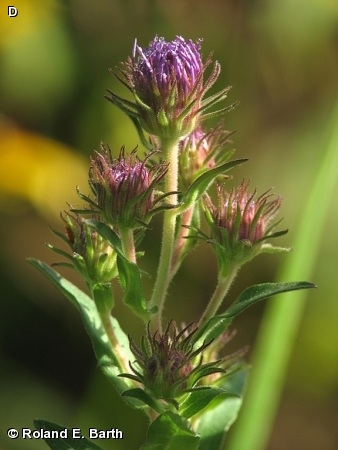
This showy, erect, native perennial has hairy stems and leaves, and grows 2-5 feet tall. Abundant, alternate leaves which clasp the stem are up to 4 inches long and 1 inch wide. Individually stalked flowers occur in one or several rounded, branching clusters at the top of the plant. The flower heads are up to 1 1/2 inches across consisting of about 50 petal-like ray florets surrounding the central yellow to orange disk florets. Rays are most often rose-purple, but may be pink to rose to lavender. Late in the season tiny white plumes attached to each seed transform the seed head into a fuzzy ball.
Grows in wet to moist prairies, thickets and open areas, flowering in September and October. At Neale Woods, it is uncommon in the Knull Prairie restoration next to the path to the viewing deck. At the Fontenelle Forest visitors center, many have been planted by the pond at the entrance way. It is also common in the recently planted Floodplain Prairie just east of the observation blind.
This plant is relatively easy to separate from most other bluish asters by its numerous clasping leaves and dense clusters of showy, rose-purple flowers.
The abundant, showy, late-blooming flowers and their ease of propagation, either from seed or root division, make this a favored garden plant.
The content of NatureSearch is provided by dedicated volunteer Naturalists of Fontenelle Forest who strive to provide the most accurate information available. Contributors of the images retain their copyrights. The point of contact for this page is: Neal Ratzlaff.